SEO & GEO
Take3
October 7, 2025
7
min read
Businesses Are Making Thousands From A ChatGPT Secret – How to Get Your Products Featured in ChatGPT
We outlined how the emergence of powerful AI assistants are changing the way we search for products. The integration of seamless AI experiences that promote commercial solutions based on user profile, context and your conversational history is opening the door to levels of brand awareness and penetration that we have never seen before.
But what exactly is the best way to get your products referenced by all the leading AI engines? In this blog we take a look at how to ensure your product remains visible while leveraging the advantage that being sourced by AI can bring.
This is an arms race for visibility in AI. The earlier you prepare, the more you win.
First, Understand: These Aren’t Ads – They’re AI Recommendations
The first thing to realise is that AI-generated results aren’t ads anymore. They are AI recommendations. Large Language Models (LLMs) like ChatGPT and Google Gemini select their results independently based on how the model interprets user intent, not what brand has paid for exposure. Its all about data quality, relevance, and building trust.
Let’s take ChatGPT for example. Its decisions are driven by a mixture of:
- The user prompt and broad conversational context
- Any custom instructions or saved preferences
- Data sourced from third-party providers, for example, structured metadata, reviews, ratings, and product descriptions
- Built-in safety filters specific to OpenAI
- OpenAI generated reasoning models
As you can see, AI assistants are more than search engines. They are contextual recommendation systems that can target and respond to specific customer profiles and requests.
Be Discoverable: Let OAI-SearchBot Crawl Your Site
As a Digital Marketer or Brand Director, how do you ensure your products appear in LLM query responses? Well, the good news is that you have a number of options available to you. For now, let’s stick with the OpenAI / ChatGPT example.
Firstly, the most important method is to make sure your website is ‘crawlable’ by OpenAI’s web crawler, OAI-SearchBot. The best way to achieve this is to check the robots.txt file on your product website and make sure ‘User-agent: OAI-SearchBot’ isn’t blocked. By allowing access to OpenAI, you are letting your content be referenced by ChatGPT.
However, it is important to note that this crawler is only used for search purposes and not to train ChatGPT’s underlying model. Once your content is accessible via ChatGPT Search, your links will include ‘utm_source=chatgpt.com’, which makes analysis of referral traffic on platforms like Google Analytics a breeze.
Optimise Product Data and Metadata
As ChatGPT relies heavily on third-party providers and your own structured metadata, it is vitally important that your product listings are accurate, logically organised, and conversationally relevant.
The best way to achieve this is to ensure that your content uses clean product descriptions and keywords that reflect natural queries. It’s best to think practically, keep the text logical and free from fluff, and concentrate on price, dimensions, ratings, and availability.
It is imperative to make use of the Schema.org markup system to ensure that AI models like ChatGPT understand what your content actually means, not just what it says.
It also pays to include labels such as ‘most popular’ or ‘budget friendly’ when writing your product content. These terms are commonly used by LLMs to generate visual tags and summaries that help users quickly grasp a product’s appeal.
Understand How Product Results Are Shaped
When ChatGPT includes product recommendations in its output, it weighs several key factors that directly influence your chances of being featured.
- Structured data from feeds and listings – This means metadata like product names, descriptions, prices, availability, and images (typically sourced from third-party providers or Schema.org markup). The more accurate, complete, and current this data is, the more likely your product is to be referenced.
- Prior model-generated responses – ChatGPT always draws on previous response patterns and internal knowledge before producing new results. Therefore, if your product has already appeared in relevant past queries you have a better chance of appearing in future recommendations.
- Reviews and third-party commentary – Independent ratings, public reviews, and user sentiment all play a significant role in influencing product selection. Positive third-party mentions increase trust signals and help the model assess a product’s popularity or quality.
- User-specific context like preferences or budget – ChatGPT tailors its recommendations based on what it knows about the user. This includes custom instructions, past conversations (if memory is enabled), and real-time prompts. Therefore, products that align with user needs (e.g. price limits, style preferences, or known dislikes) are more likely to be included in its output.
It’s impossible to game LLMs. Using AI assistants to boost your commercial strategy represents a shift from the rigid, pay-to-play structure of traditional search engines and creates a more democratic and intent-driven discovery experience. Therefore, it is imperative that you learn to speak the language of user intent and provide website content that clearly answers the most likely queries.
Write AI-Optimised Content That Describes the Product Experience
So now you know how to make your content more searchable, how can you optimise your content for LLMs? Unlike search SEO, AI search is about context and clarity. It is important to use full sentences, for example –
“This smartwatch works seamlessly with Android phones, has built-in GPS, and lasts over 4 days on a single charge.”
This helps the model understand your product’s value in a broader context rather than relying on keyword-stuffed titles. It also helps to generate additional supporting content such as:
- FAQ pages
- Gift guides
- Comparison blogs
- User scenarios (e.g., ‘Best travel headphones for introverts’)
By adding supporting pages to your website, you ensure that your content is absorbed into the AI model, giving your brand greater visibility in any relevant queries.
Sign Up for Future Product Feed Submissions
As far as we know, OpenAI is currently working on a direct product feed system that enables merchants to upload their listings to ChatGPT in a similar way to the Google Merchant Center.
However, right now, it isn’t yet possible to submit a feed directly, but you can sign up to be notified when it launches.
Once it launches, this is certain to be a game changer, allowing merchants to promote accurate, real-time listings directly into the ChatGPT output feed.
Build a Custom GPT Assistant for Your Store
While the placement of your products and the likelihood they will be referenced are still based on algorithms, you can take matters into your own hands by designing a custom GPT.
While daunting, this approach is not as complicated as it sounds. By doing so, building a custom GPT would let you:
- Recommend products based on user prompts
- Up-sell based on previous queries
- Link users to product pages
- Provide live inventory status via APIs
This idea works best if you already have a proactive community and an engaged audience. It has been proven to work especially well on Discord and Telegram communities, as well as performing well on X and your own direct-to-customer database. All you need to do is embed the AI assistant on your website or include it prominently in any promotional campaigns that prioritise social media.
Understand the Role of Reviews, Summaries, and Star Ratings
One of the most important factors to consider is that ChatGPT often summarises product reviews from across the web, showing both pros and cons. This output is generated by AI and not user-submitted. Therefore, it may also show:
- Aggregated star ratings
- Comment trends
- Label summaries like ‘Popular with pet owners’
Remember, these insights are pulled from publicly available data and, as a consequence, are not verified by OpenAI. It goes without saying that if your products have favourable customer reviews or if they feature regularly in guides and comparison websites, you are more likely to be favoured by LLMs.
What’s Next? Stay Ahead!
So by now we hope that you have a better picture of how AI is changing how we search for and appear in product listings. As you might expect, things are moving rapidly, so it pays to be forearmed. However, the AI shopping interface is just beginning. As we progress through the 2020’s we should also expect to encounter:
- A growing emphasis on platform integration: Expect AI to directly link products from various sources into the shopping interface without external redirects. (Elon’s ‘do everything’ app?).
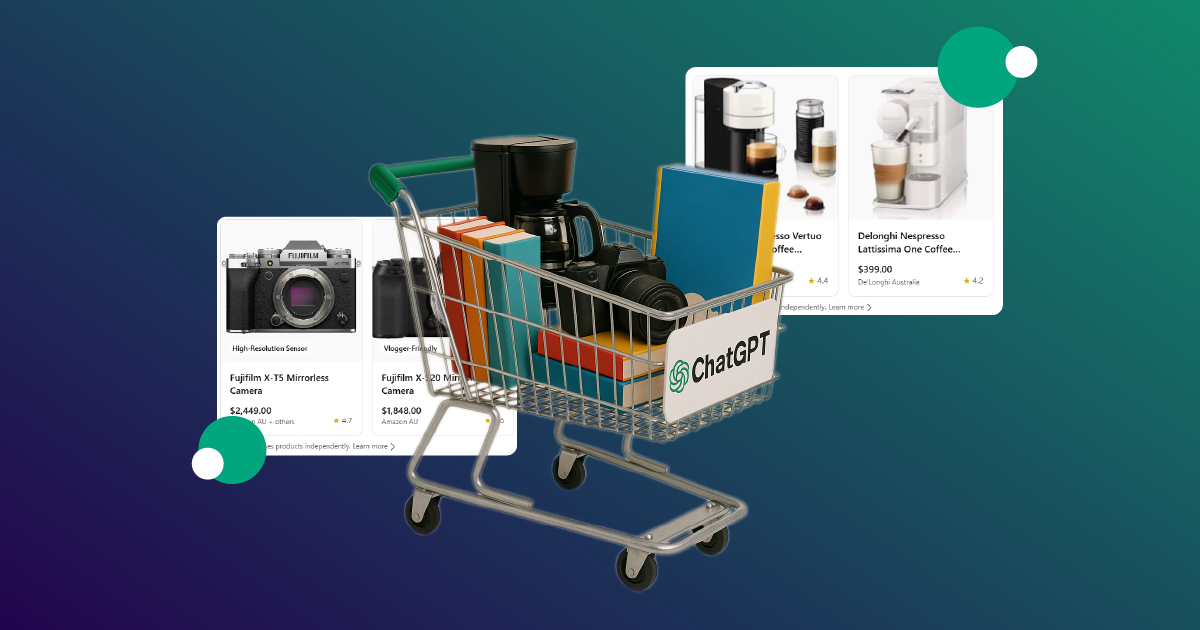
- Richer product carousels: Product displays will become more interactive and detailed, offering enhanced visuals and immediate purchase options within the AI environment.
- Performance feedback loops based on user clicks: AI will continuously learn and improve product rankings and recommendations by analysing what users decide to click.
- A monetisation layer: Your favourite AI shopping interface is likely to introduce methods that allow businesses to pay for increased visibility or preferential placement within product listings. Micro (crypto) payments anyone?
However, right now, the AI landscape is still up for grabs. One thing we can be certain of is that, as always, early adopters get a head start.
Final Thoughts: Embrace AI-Driven Product Recommendations
Without a doubt there is a lot to take in. But, as with most AI advancements, the thinking behind the progress is logical and user-friendly. To be succinct, we’re moving from searching for products to asking AI for recommendations. Be learning how things are changing. This is your moment to get ahead of the curve. Ultimately, the question you should be asking yourself is –
‘Will ChatGPT recommend my product?’
So, to recap, to take advantage of the rise of AI assistants, it is imperative that you –
- Make your content crawlable
- Make your listings structured
- Make your product information genuinely helpful
In doing so, you will not only ensure that your products are routinely featured by the leading AI models of today, but you will also thrive in this new era of AI-driven commerce with content that is precisely what customers look for, discover and choose.
Ready for an AI-ready commercial strategy or a digital marketing audit? Contact us today to discuss your requirements.