Menu

A Step by Step Guide on How to Optimise your Content for Inclusion in LLM Public Datasets
In the modern world of web content marketing, one thing is becoming clear. We no longer write just for humans. Today’s most powerful audience is machine-based, made up of Large Language Models (LLMs) like ChatGPT, Gemini, Claude and Grok. These models do not just summarise the web. They define what gets seen, cited, and surfaced across billions of user interactions.
If your content is not being sourced by these models, it is effectively invisible to the next generation of search and discovery. The rules of SEO still matter, but there is a new game in town: Artificial Intelligence Optimisation (AIO), also called LLMO, or simply SEO for LLMs.
AIO, or Artificial Intelligence Optimisation, is the practice of structuring and distributing content so it gets included in the datasets LLMs are trained and retrieved from.
This guide will take you through step by step how to get your content into the datasets that LLMs are trained on, how to structure it so it gets picked up and cited, and how to future-proof your work for an AI-first content landscape.
If your content strategy is not adapting, it is dying!
But you don’t have to accept that. Let us help you learn more about how to fix it.
How and Where People Find You
Licensing is worth thinking about, but not for the reason most people assume. LLMs have demonstrably trained on copyrighted material, so an open licence is not a prerequisite for inclusion. What it does change is your legal position: it removes ambiguity for downstream reuse and makes your content easier for curated, licence-filtered datasets to pick up. That’s a real but narrow benefit, and it costs you commercial control over your own material.
Beyond licensing, your content needs to be public, crawlable, and hosted on platforms that the leading AI trainers actually access. Use public platforms that are well known and crawl friendly, such as GitHub for code, ArXiv for research, Stack Overflow for technical Q&A, Medium, Quora, Reddit and Wikipedia, which remain some of the most popular and accessible destinations today.
Avoid content gating, and keep your content out from behind paywalls, log-ins, or restrictive terms of service; it should stay free to read and easy to access. Enable crawling by making sure the site hosting your content allows indexing via permissive files such as robots.txt, and use clear content structure, including headings, alt text, and metadata, to improve machine readability. Following these steps increases the chances of your content being included in the public datasets that LLMs draw on when training and augmenting their data.
Make Your Content Easy to Read
There are a number of key technical processes you should adopt to make sure your content is being seen.
Use Clean HTML
It is important to use clean HTML and semantic markup at all times, structuring your content so it is easily understandable by both humans and machines.
- Use heading tags properly, with H1 for the main title and H2, H3 and so on for subsequent subtitles.
- Make use of semantic tags such as <article>, <section>, <nav>, and <footer> to indicate the role of each block of text.
- Include descriptive <title> and <meta name=”description”> tags along with structured data, so search engines and data crawlers understand the context.
Clean, well structured HTML increases the likelihood of AI crawlers parsing and indexing your content accurately, which makes it more likely to be used in AI training and retrieval systems.
Schema tags for articles, products, reviews, etc.
Using schema.org tags helps AI understand the meaning behind your content rather than treating it as just words on a page.
An article that uses the “article” schema, for example, helps define the author, publication date, headline and copy.
Content that uses the “product” schema can communicate data such as price, availability, reviews and ratings, and it is also possible to design your own schema type for individual classifications.
Minimise clutter
Keep clutter, including popups, excessive JS, and gated forms, to an absolute minimum. This makes your content easier to crawl and ensures search engines and AI scrapers can access and process it quickly and smoothly.
Use Canonical URLs
Use canonical URLs to avoid duplication issues. Canonical URLs tell search engines and AI crawlers which version of a page is the original or preferred one, which is especially helpful if you have duplicate or highly similar content across multiple URLs.
This way, the right content gets used rather than overlooked or ignored.
Rank Well So AI Notices You
AI LLMs typically favour high ranking content over content that sits further down search results, so making sure your content ranks well on an SEO basis matters.
Clear, concise, factually correct and well structured content is equally as palatable for LLMs as it is for humans, and natural, question based language, such as FAQs, how-tos, and “what is” framing, has also proven more effective than bland or overly colourful writing.
Favouring evergreen content also helps your work remain relevant over a much longer period. This kind of content is more likely to be crawled, indexed and used in LLM training models because of its consistency and long-term value, which reduces the need for frequent updates.
Building Credibility and Authority
Humans take greater notice of information that comes from credible sources, and the same is true of machines. It is important to ensure your content carries weight and is used by reputable, authoritative sources.
One of the most effective ways to achieve this is to get cited and referenced by sites already known to be high-authority, such as the BBC, Reuters, The New York Times, The Guardian, or The Verge; LLMs tend to favour content that comes from such sites.
Another technique is to incorporate links and quotes from research backed or thought-leadership content on well known and crawlable publications, including Medium, Dev.to, Substack and HackerNoon.
A May 2026 survey of 500 marketers and business owners by NP Digital, the agency co-founded by Neil Patel, put numbers behind which signals actually drive AI visibility, and the results reshuffle a lot of assumptions from traditional SEO.
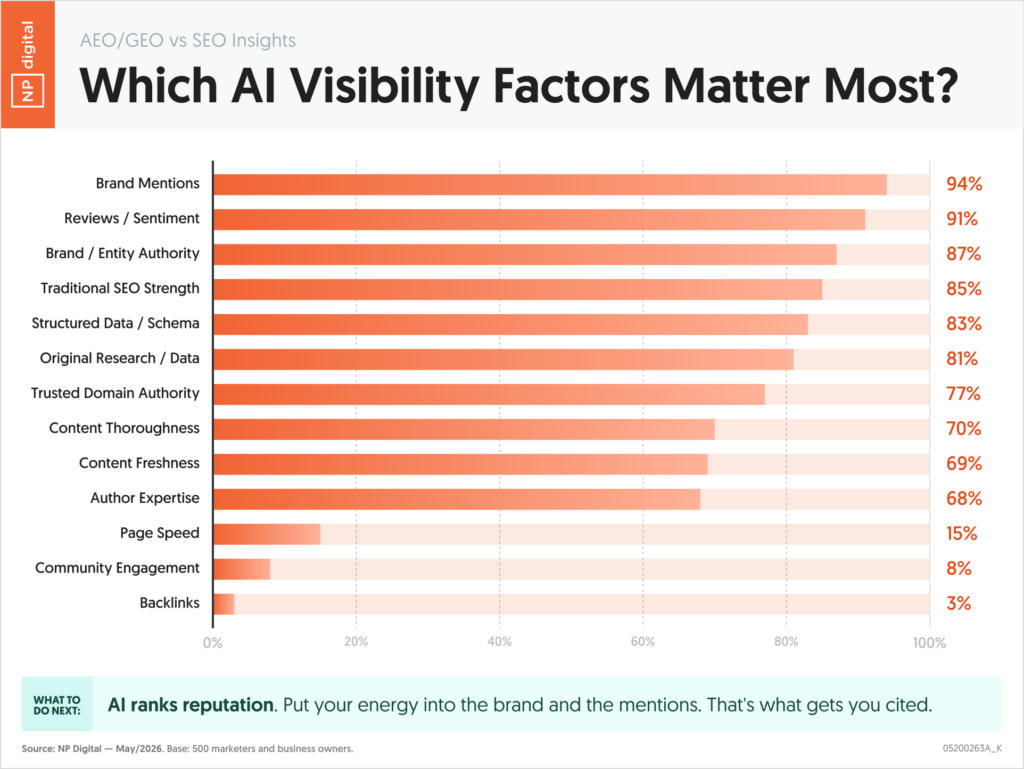
Brand mentions came out on top, rated as important by 94 percent of respondents, the highest score in the study.
Reviews and sentiment followed closely at 91 percent, with brand and entity authority at 87 percent and traditional SEO strength at 85 percent rounding out the top four.
Structured data and schema markup came in at 83 percent, and original research and proprietary data at 81 percent.
Backlinks, by contrast, ranked dead last among the 13 factors measured, at just 3 percent, a sharp break from their central role in traditional SEO ranking.
As Patel put it, AI engines are trained on “what people say about you, not what you say about yourself.” That explains the clustering at the top of the list: brand mentions, reviews, and entity authority together suggest that AI visibility is less a content problem and more a reputation one. A brand with average content but a strong footprint of third-party mentions and reviews is likely to outperform a brand with excellent content but little external presence. Neil Patel
For Take3 clients, this points to a few concrete priorities: building a deliberate brand mention program across the 15 to 20 publications and communities most relevant to your category, treating review generation as an ongoing operational habit rather than an afterthought, and investing in original research your competitors cannot simply reproduce.
It also means link building, while still useful for traditional search, should not be the centrepiece of an AI visibility strategy going forward.
Source note: NP Digital, “Which AI Visibility Factors Matter Most?” (May 2026), neilpatel.com/marketing-stats/which-ai-visibility-factors-matter-most.
Expand Where Your Content Lives
Where you distribute your content should match what kind of content it is. If your business produces code, documentation, or technical research, platforms like GitHub and ArXiv are exactly where AI trainers look for that material, and getting it there matters more than almost anything else on this list.
If your content is more general, such as guides, opinion pieces, or brand storytelling, the platforms that matter most are different, think Medium, Substack, and industry publications rather than code repositories.
To increase the chances of your content being used in AI LLM datasets, focus on increasing its visibility and credibility signals. Inbound links from reputable sites boost your domain’s authority, which makes your content more discoverable and prioritised by web crawlers.
To build credibility further, syndicate or cross-publish your content on AI friendly platforms such as GitHub for code, ArXiv for academic work, and Medium for general articles, so your content lives where AI trainers are already looking. Having your content quoted or published in high-traffic newsletters or major blogs extends its reach and improves the chances it gets used in future LLM updates.
Beyond that, consider listing your work in public datasets such as Papers with Code, Kaggle, or GitHub repositories. These platforms are frequently used by AI developers and model trainers, and content hosted there has a higher chance of being absorbed by LLMs.
You can also contribute to wikis, open source knowledge bases, and collaborative forums like Stack Exchange, and integrate your content into Reddit AMAs to help it become part of the active, crowd-sourced data that AI models draw on for reference. Submitting content to dataset-focused projects such as LAION or Common Crawl, which aggregate large amounts of publicly available data used to train LLMs, is another option worth considering.
Check If It’s Working
The monitoring and feedback loop is essential to the success of any business, and the same applies to AI friendly content. Dedicated tools that confirm whether your content was used in AI training are not yet widely available, but a few workarounds can help.
You can test AI models by asking specific questions that you know should reference your data, ideally around phrases or niche subjects unique to your content. Tools such as Perplexity AI or You.com show citations, which you can monitor to see if your content is being sourced. You can also set up alerts for backlinks or specific mentions to catch AI-generated content referencing your original work.
Advanced Moves for Teams Ready to Go Further
AI models have a direct influence on how users discover content, so it is worth going beyond the basics.
Optimise for Featured Snippets and Direct Answers
LLMs often draw on content that ranks in Google’s featured snippets or “People also ask” boxes. Structuring your content using Q&A formats, numbered lists, and concise summaries improves visibility in both search engines and AI interfaces.
Use Behaviour Insights to Refine Structure
Tools like Microsoft Clarity or Smartlook help analyse how users engage with your content. Heatmaps and scroll-depth tracking can reveal which areas hold attention and help you improve clarity, formatting, and relevance.
Promote and Share Strategically
The more eyes on your content, the more likely it is to be linked, indexed, and discovered by both humans and machines. Sharing content consistently across social media, cross-posting to relevant platforms, and pursuing digital PR opportunities all help widen your reach and keep your content circulating, which increases the chances it gets picked up, referenced, and cited by AI systems as well as by human readers.
Stay Relevant as AI Keeps Changing
Future-proofing your work with intentional strategies helps keep your content relevant and accessible as the AI landscape continues to move.
Focus first on creating unique, high-value content. Deep analysis, original research, and expert insight stand out, because AI models tend to prioritise authoritative and distinctive sources over generic material. It is also essential that your content is structured for AI understanding, using clear, semantic HTML headings, well organised sections, and Schema.org markup; this helps you rank well with search engines and makes it easier for AI systems to parse and accurately source your content.
Prioritise evergreen topics with lasting relevance, since they attract attention over time and retain higher value in AI training datasets, and revisit and update your content regularly so it stays fresh and competitive without becoming static. It also pays to be aware of how AI may summarise or repurpose your work: break complex ideas into shorter sections that can be easily extracted and reassembled, which increases the likelihood of your content being used in AI applications.
Use analytics and AI tools to monitor how your content performs. These can help identify knowledge gaps you may have missed and spot emerging trends, and continuous iteration based on data-driven insights will help your content evolve alongside AI capabilities.
Building strong brand and domain authority also matters, since AI models favour sources with high credibility; invest in backlink strategies, consistent branding, and active community engagement to reinforce your authority and visibility.
Finally, stay informed and proactive about legal and ethical developments. Keep track of evolving copyright laws, licensing options, and industry best practices, so your content remains eligible for AI inclusion and you retain control over its use.
Get Your Team on the Same Page
Even if you plan to bring in outside expertise for the execution, it helps to have your internal team fluent in the basics of LLM SEO. When your content writers, developers, and marketing leads understand why open licensing, clean HTML, and schema markup matter for AI visibility, they make better day-to-day decisions and stop undoing the work an agency puts in place.
A good starting point is a short internal briefing that covers what AIO is, why it matters for the business, and roughly how LLMs source and cite content.
Sharing a version of this guide internally is an easy way to do that. From there, it is worth designating one or two people, likely from marketing or content, as points of contact who understand the terminology well enough to brief stakeholders and answer basic questions, without needing to become specialists themselves.
This kind of AI visibility work also changes quickly, since the platforms, their citation behaviour, and the best practices around them are still being worked out in real time. Most in-house teams do not have the capacity to track those shifts alongside their existing workload, which is exactly the kind of ongoing, specialised effort worth handing to a dedicated partner.
Building enough baseline literacy for your team to be informed collaborators, while leaving the implementation and monitoring to an agency like Take3, tends to get the best of both: a team that understands what is happening and why, and a partner who keeps the work current as the landscape shifts under it.
Conclusion
AI LLMs have the power to become the default interface for accessing, interpreting and distributing knowledge across the world, and the rules of engagement for this are still being written in real time.
Visibility is no longer just about search rankings. In an AI-driven world, visibility is about being included in datasets, retrieval engines, and the generative outputs that billions of users now rely on. We are entering an era where online content is more likely to be read by machines than by humans, and the influence of that content is shaped not by clicks but by how AI cites, paraphrases, and reuses your insights.
This calls for a strategic shift for content writers, brands, thought leaders, and publishers alike. Understanding how content is sourced and used by LLMs is essential. Just as SEO defined the last ten years, AIO, or Artificial Intelligence Optimisation, is set to shape the next. Aligning your content with how LLMs operate is key not only to the success of your content marketing function, but to its survival.
Here at Take3, we help forward-thinking brands optimise their content marketing for both humans and intelligent systems. Whether you are building LLM friendly architecture or working through the unsettled ethical questions around content discovery, we can help.
Reach out to us today to help optimise your SEO for LLMs.
This monumental shift is happening right now. Make sure you don’t get left behind.
Future-Proofing Your Content Strategy for the AI Era

How to use AI in Web3 Marketing without losing trust
This article was written by Louise Macfarlane, Web3 Strategist at Take3. Most Web3 teams already sit…

Crypto KOL Disclosure: How Web3 Brands Keep Paid Partnerships Compliant in 2026
Author of this article is Lachlan Andrews, Web3 Strategist at Take3 With the rise of KOLs and influencers in recent years, many Web3 businesses and…

Web3 Community Building in 2026
This article was written by Louise Macfarlane, Web3 Strategist at Take3.The Web3 community playbook from a few years ago is mostly dead and buried.
Apply to work with us
Step 1 of 2 — Your Details Almost there Question ${ quizStep } of 7
Tell us about yourself
${ q.hint }
${ q.question }
Is there anything else you'd like us to know?
${ quizCategory }
Your project has potential, but trust signals are thin. Before you scale marketing, you need to build the foundation. That's exactly what we help with.
You've got some trust building blocks in place, but there are gaps that could hold you back. The good news: this is fixable and we know where to focus.
You've built real credibility. The question now is: are you owning the narrative, or letting someone else define it?
We'll be in touch to share what we'd prioritise first.
You've been accepted for a Trust Strategy Call. We'll be in touch to book it.
Sending your results...
${ quizError }