Growth & Community
Take3
March 8, 2026
11
min read
The Invisible Infrastructure of Web3 Quietly Built by Women
Web3 is built on the idea of decentralisation.
The principle of which is that power, access and value should not sit with a single gatekeeper, but should be distributed across a network of peers. It is a technical architecture. It is also, it turns out, exactly how women in this industry have been operating all along.
There is a moment that happens at almost every Web3 conference. You are in a bathroom with no queue for a change, because there are never enough women to create one, and as you finish up and get yourself together to head back out into the crowd, you end up in a random conversation with the woman next to you.
She does not know anyone either, or she is the only woman on her team, or she has just flown in from somewhere and is not entirely sure why she said yes to this. Within a few minutes, contacts have been swapped, a plan has formed to meet at the side event later, and she has an introduction for you that might change the whole event for both of you.
This happens constantly, in bathrooms and coffee queues and corners of conference halls where the noise is slightly less overwhelming. Women find each other, take stock, and we are quietly redistributing access.
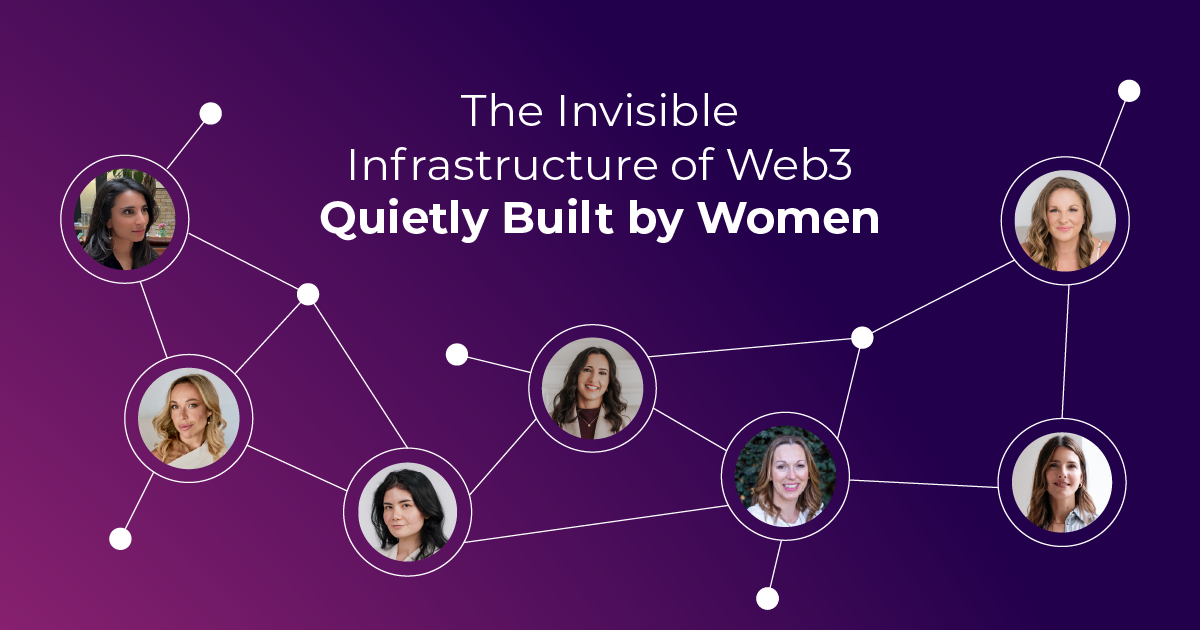
For International Women’s Day 2026, at Take3 we wanted to share the stories of women like us, who are building across the Web3 ecosystem. Our shared backgrounds span continents, roles span everything from institutional finance to grassroots education, and our entry points into the space could not be more different. However a thread of commonality runs through all of our journeys, which is a natural curiosity, an internal instinct to connect and share knowledge, and a desire to change the systems from the inside.
The Network that Predates the Protocol
Before any of the formal structures that now exist to support women in Web3, there was the informal one of women connecting with other women. This was done by sharing job leads through DMs, pulling someone into a group chat when they seemed like they needed it or sitting down with a young founder for an hour because no one had done that for them.
This is not sentiment or a strategy. It is just the way many of us are wired, and it mirrors, almost exactly, what blockchain technology was designed to do, to remove the central authority, distribute the value, and let the network carry it.
What makes this particularly interesting is that women have been building this kind of network not because they read a whitepaper about distributed systems, but because the centralised alternative, the traditional corporate ladder, the old boys’ network, the conference circuit dominated by the same faces on the same stages, was not built with us in mind. When the existing architecture does not serve you, you build a different one and that is precisely what is happening.
Building Differently from the Beginning
Renee Francis founded Take3 because something felt wrong about the traditional corporate model, and she wanted to test whether there was a better way. The answer, it turned out, was remote work, not as a pandemic concession, but as a deliberate design choice. By building a company that was location-independent from day one, Renee created positions that suit mothers, carers, people rebuilding after a break, and talented professionals who had been passed over by organisations that confused presence with productivity.
The result has been a team that produces excellent results, is loyal, and appreciates and values each others time, not despite the flexibility but because of it.
That is not a coincidence.
When you design systems that work for people with complicated lives, you attract people who are good at navigating complexity. When you trust people to manage their own time, you find out quickly who is worth trusting. And when you stop requiring everyone to operate in the same place at the same time, you discover that the talent pool is significantly larger than the one visible from a single city’s office market.
This is decentralisation applied to work.
The same principle that makes blockchain valuable, that you do not need a central authority to coordinate value between peers, also makes remote, trust-based teams more resilient and more human than their centralised counterparts.
Renee understood this before it was widely accepted. The companies scrambling to redesign their workplaces now are arriving at a conclusion she started building toward years ago. The real measure of any system is not only the principle behind it but what it makes possible for the people inside it.
People like, Louise Macfarlane, a Web3 Strategist at Take3, Web3 Woman of the Year in New Zealand and founder of the Crypto Women Australia and New Zealand community group, who knew that work ran in parallel with everything else that life requires, shifting careers, family commitments, countries that changed, and the constant work of rebuilding and starting again.
For years, her community work found its home in the margins of early mornings, late nights, the hours that did not officially belong to anyone. Louise built Crypto Women Australia and New Zealand the way most women build things alongside a career, with careful and consistent work and without fanfare. She found ways to make it work around everything else, and discovered that Web3 was quietly creating a different kind of opportunity.
Web3 is a space where location matters less, where skills travel across borders, and where reputations are built through genuine community work that open doors that traditional CVs don’t.
The roles she found in Web3, first with Easy Crypto and then here, at Take3, were built around flexibility as a founding principle rather than a reluctant concession. She discovered that her Web3 newsletter, the community who enjoyed it, connected with women on different stages of their journeys, all looking for new and different ways of doing things.
Women looking for the right structure and systems which makes room for the person, rather than forcing them into outdated structures.
What Women Are Building in Web3
Take3 spoke with women building across the Web3 ecosystem leading up to International Women’s Day to learn about what inspires them and what they would share with other women thinking about joining the space.
Their backgrounds are different, their entry points were different, and what they are working on is different. But a common thread runs through all of them, that did not know where they were heading when they started, they just took a leap of faith and started.
Knowing where she wanted to be, but not knowing exactly how to get there, Serena Dhanani, was working at, J.P. Morgan when a role opened in the digital assets division, she took a leap and jumped into institutional partnerships across the Web3 ecosystem.
“The people designing the infrastructure today will influence access, governance, and capital flows tomorrow,” she said. “Greater female participation will lead to stronger decision-making, better risk management, and more inclusive products overall.”
This is not a case for diversity as a moral good but as a technical one as the network is better when there is a diverse range of people building it.
“I’ve never felt as supported by a female community as I have in this space and that’s not something I expected.” Paulina Tylus, Zodia Markets
Paulina Tylus, Global Partnership Lead at Zodia Markets, had a successful career in a variety of industries before making her way into the Web3 space where she has gone from strength to strength.
Her personal experience feeling that level of support is remarkable in an industry that is still majority male and still has considerable ground to cover. But she meant it, and she was not the only one who said something like it.
While this was echoed by Danielle Marie, founder of EvolvH3R, who has delivered blockchain education to hundreds of students across the globe and is now building a global education hub through All Things Blockchain, this wasn’t what she experienced when she entered the space in the early days.
With her years of experience in the Web3 space, Danielle Marie is at the forefront of creating the communities that welcome in newcomers like Paulina.
“I wanted to create the community I wished had existed for me,” she said. “A space where women can connect as industry peers, share their stories, and support each other without having to fight for the right to be taken seriously.”
Danielle Marie is building a social good initiative, which is also, by any reasonable definition, decentralisation in practice, the distribution of knowledge and access across a network rather than concentrating it at the top.
Why This Matters Beyond the Conference Circuit
There is a version of this conversation that stays safely inside the industry. Women supporting women in Web3, good, good, that’s nice, noted, moving on. But that framing misses something important.
The financial systems that Web3 is disrupting were designed, largely, by people whose domestic and social needs were managed by others.
That is not an accusation, it is a description of how the architecture of systems were set up. The result are systems that work well for people who operate the straight lines of a single career trajectory with uninterrupted years of focus and progression, with no gaps, no pivots, no years of managing someone else’s care around their own working day.
But these systems were not designed for anyone who has ever had to hit pause, rebuild, or figure out how to work from anywhere because anywhere kept changing.
The women in this space are not waiting for those systems to be redesigned from the top down, they are doing it themselves, through networks that distribute and decentralise rather than concentrate.
When Flo Vuong couldn’t find her place within the Web3 space, from good merch at a conference that was stylish and comfortable for a woman, or a safe and connected space, she set out to build it, not only for herself, but so she could support others on their journey.
OrginalCopy Merch Studio, which sets out to provide stylish merch options for women in Web3, that won’t make them cringe, and Babes net is a growing community of more than 500 Web3 women, both evolved not because Flo had a mission statement but because other women have different needs and wants, and Flo is there, creating and building changes that she wants to see in the space.
“I love my girls and I want them to succeed.” Flo Vuong, OrginalCopy Merch Studio & Babes net Co Founder
And that sort of community focus and support is what Web3 helps women build and lean in when times get tough.
Being laid off is the kind of tough time many professionals quietly absorb, update the LinkedIn profile and hope nobody notices. But when it happened to Dayana Aleksandrova, she did the opposite. When she posted about it publicly on X, honestly and without apology, laying out what she had built, what she brought to the table, and what she was looking for next, she didn’t quite expect what would happen next.
Within 24 hours she had 12 interviews, one of which was with WalletConnect, where she now leads Social and New Media, after being promoted twice.
That is not a lucky outcome. It is the return on years spent genuinely connecting with people rather than simply collecting them. The network activated because it was real, and because she had spent her time in this space being useful to others long before she needed anything in return.
It is also a signal about how the world of work is changing. The old gatekeepers are increasingly less relevant than the trust built in public, over time, with people who actually know what you can do.
Work That Doesn’t Make The Stage
The women doing some of the most important work in this space are often not the ones on the main stage. They are not the keynote speakers or the panel chairs or the faces on the conference billboards. They are the ones running the side events, building the Telegram groups, doing the education, writing the newsletters, sitting down with the nervous newcomer and explaining how the wallet works.
This is not simply a consequence of being underrepresented at senior levels, though that is also true and worth addressing.
It reflects something about the kind of work women tend to do in this space: the connective, supportive, educational work that does not generate the noise that gets you on a stage but generates something more valuable over time.
Trust. The kind that accumulates quietly and does not disappear when the market turns.The kind of trust that means when Dayana posts about a layoff, twelve companies want to talk to her the next day.
The kind that means when Flo hands someone a pink Babes net keyring at a conference, that person feels like they belong somewhere real.
“Confidence often follows action, not the other way around.” Serena Dhanani
None of that is on a slide deck or in some board report, but all of it is rebuilding the Web3 industry.
Where Are We Heading
The daughters of the women in these conversations will grow up in a world that is genuinely different from the one their mothers navigated. More unstable in some ways and also more open in others.
And what we need to be reflecting on during International Women’s Day and on every other day, is what kind of communities are we creating and what sort of financial and digital infrastructure we are handing to future generations.
What Web3, at its best, is capable of redesigning systems that do not require you to fight your way in.
Systems where access is not contingent on fitting the right profile, or having had a career in exactly the right shape and order.
Systems that work for the half of the world that has historically been treated as an afterthought in the system design process.
We are not there yet, but the women in these conversations are building toward something real, an infrastructure that works for the people it has historically ignored, and a culture of collaboration that the industry keeps saying it wants, yet keeps undervaluing when it shows up.
That last part matters. Women in this space give generously with their time, knowledge, introductions, mentorship, hours that never make it onto a timesheet.
That generosity is not a weakness.
But it has limits, and the industry has a habit of treating those limits as someone else’s problem. Helping with meaning is not the same as working without compensation.
The network that no one built on purpose is already working. The only question is whether the people sustaining it will finally be paid what they deserve for doing so.
The women featured in this article are part of Take3’s Faces of Web3 series, which will be published throughout March and April 2026 . Keep an eye out for their full interviews at take3.io.